
Welcome, students
Thanks for stopping by our booth. Student membership in NIBA is completely free — it takes a couple of minutes to join, and it puts your resume in front of the firms that hire in this industry.
Join freeWho we are
The National Introducing Brokers Association is the trade association for the derivatives industry — introducing brokers, guaranteed introducing brokers, commodity trading advisors and commodity pool operators. We have been the united voice for derivatives professionals since 1991.
NIBA represents members before regulators, runs conferences and symposia across the country, and keeps the industry connected through education, networking and a shared set of professional standards. Our members range from one-person shops to some of the largest futures commission merchants in the business.
If you are studying finance, economics or business and want to know what a career in futures and derivatives actually looks like, this is a good place to start.
Careers in futures
From our university outreach series: how a futures trade moves from customer to broker to exchange, and the jobs at every step — brokerage, risk, operations, compliance, technology, and trading — plus how to land your first seat.
Read the slide text
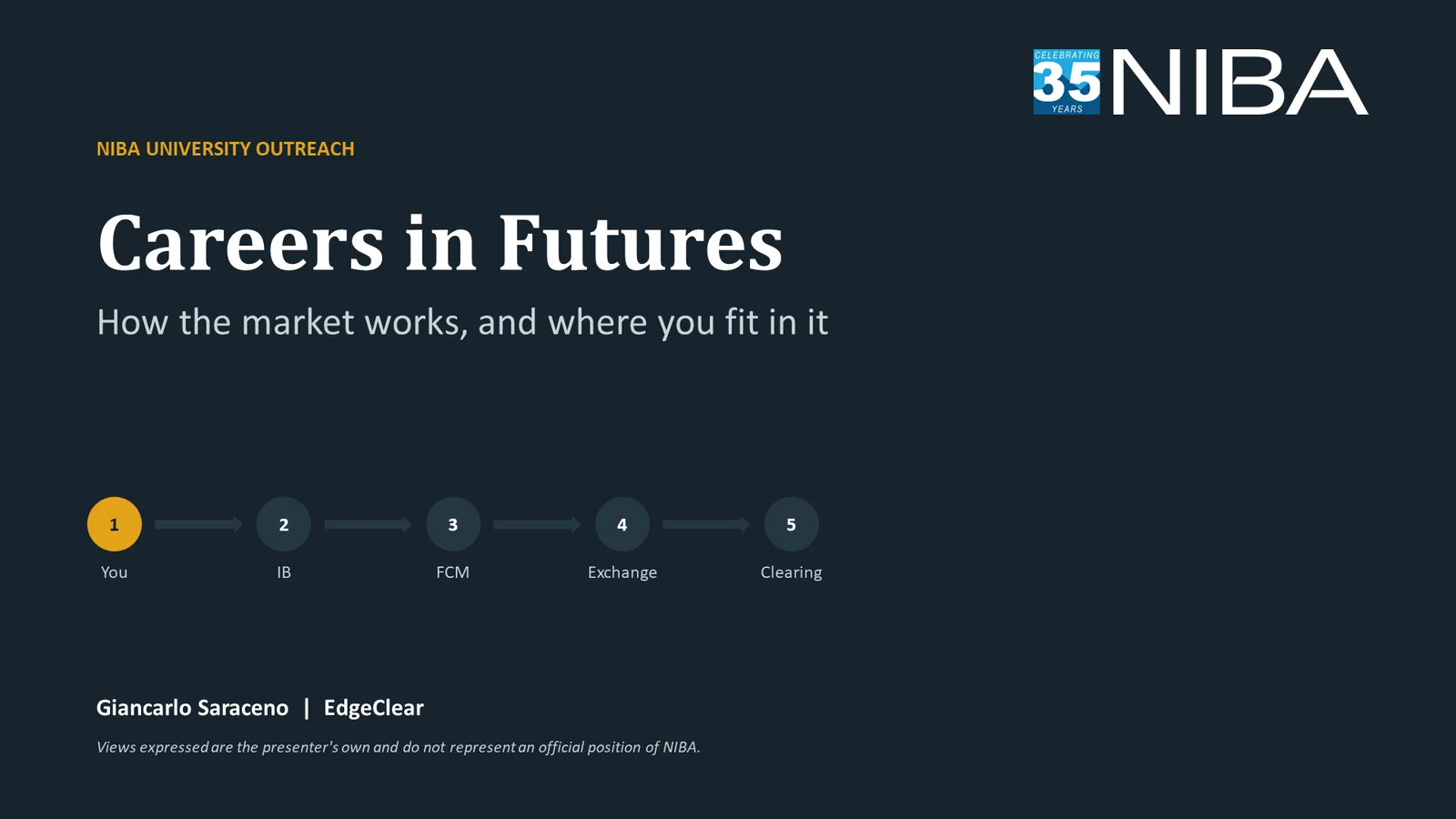
1. Careers in Futures
NIBA University Outreach — how the market works, and where you fit in it.
The chain: You → IB → FCM → Exchange → Clearing. Presented by Giancarlo Saraceno, EdgeClear.
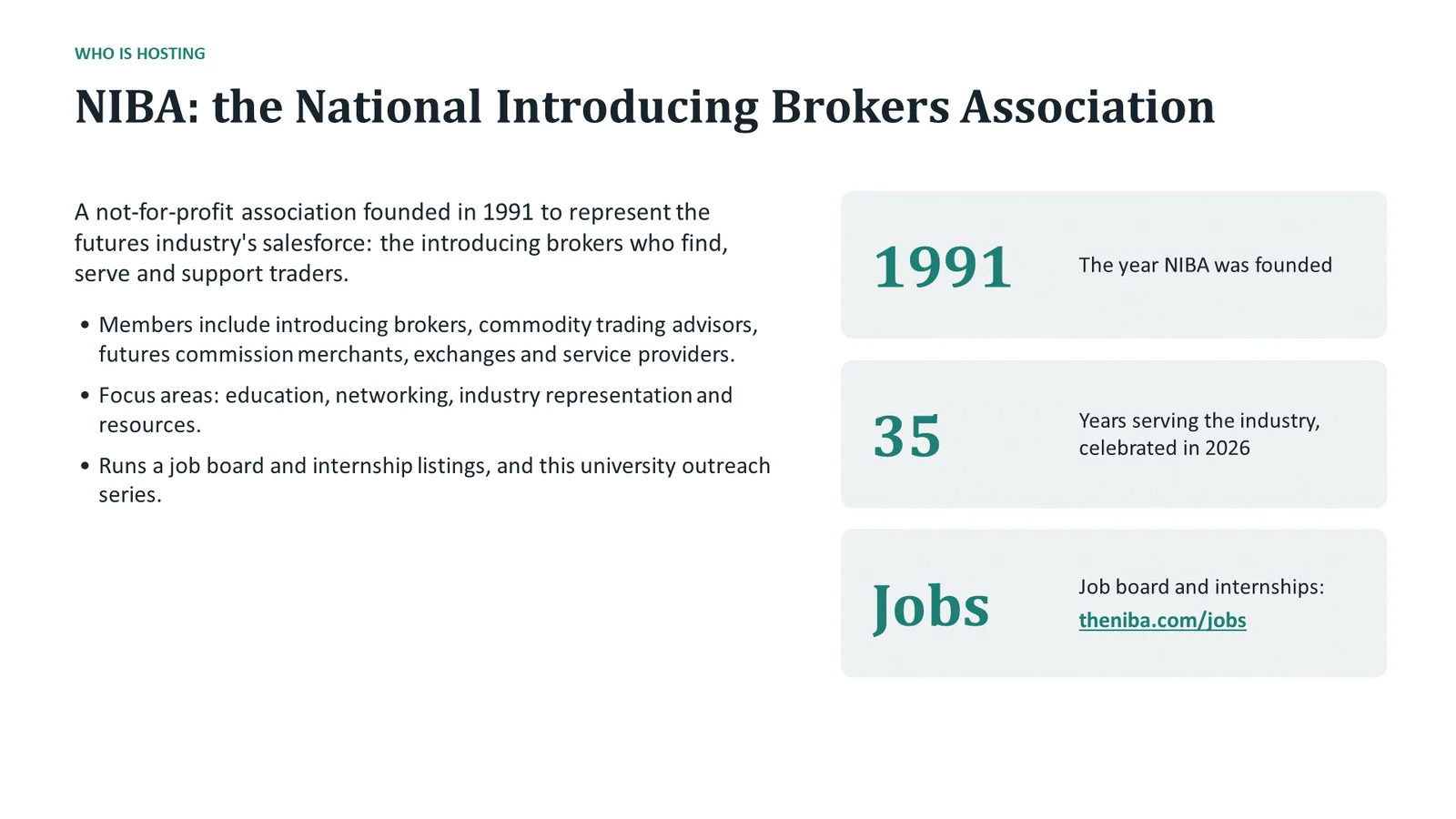
2. Who is hosting: NIBA
A not-for-profit association founded in 1991 to represent the futures industry's salesforce: the introducing brokers who find, serve and support traders.
Members include introducing brokers, commodity trading advisors, futures commission merchants, exchanges and service providers. Focus areas: education, networking, industry representation and resources.
NIBA runs a job board and internship listings (theniba.com/jobs) and this university outreach series.
3. What is a futures contract?
A standardized agreement to buy or sell something at a set price on a future date, traded on a regulated exchange.
Hedgers are businesses that want less risk — a farmer locking in a price for next fall's corn, an airline locking in jet fuel, a bank protecting against rate changes.
Speculators take on that risk for a potential profit and add liquidity, from individuals to large funds.
What trades: corn, crude oil, gold, the S&P 500, interest rates, currencies, even bitcoin.
4. Who does what
You, the customer: an individual, fund or business that wants to trade or hedge.
Introducing Broker: finds and services customers and accepts their orders; does not hold customer money.
Futures Commission Merchant: holds customer money, extends margin, manages risk and carries the accounts.
Exchange (DCM): where buyers and sellers meet — CME Group, Cboe Futures Exchange, ICE Futures U.S.
Clearinghouse (DCO): stands between every buyer and seller and guarantees the trade.
Regulators: the CFTC (federal regulator) and the NFA (the industry's self-regulatory organization).
5. Following a single trade
The order: the customer places it, the IB provides relationship and service, the FCM runs risk checks and routing, the exchange matches buyer and seller, and the clearinghouse guarantees the trade.
The money: the customer deposits funds directly with the FCM; the IB never touches customer money; the FCM keeps customer futures funds segregated and posts margin; the exchange publishes prices and sets the rules; the clearinghouse settles gains and losses every day.
Watching every step: the CFTC and the NFA. Not every FCM clears its own trades; many clear through a larger FCM that is a clearing member.
6. Introducing Broker vs. FCM
Main job — IB: find, educate and service customers and accept their orders. FCM: hold customer funds, extend margin, execute and carry accounts.
Customer money — IB: cannot accept or hold it. FCM: holds futures customer funds in segregated accounts.
Capital — IB: lower requirement, or guaranteed by an FCM. FCM: much higher requirement, reported to regulators regularly.
Oversight — both register with the CFTC and are NFA members; FCMs also follow exchange and clearing rules.
Typical jobs — IB: brokers, client services, marketing, business development. FCM: risk, operations, compliance, finance, technology, client services.
7. Careers beyond the trading desk
Brokerage & client relations (first seat: junior broker, Series 3) · Risk management (risk analyst) · Operations & clearing (operations associate) · Compliance & AML (compliance analyst).
Technology (junior developer) · Finance & regulatory reporting (regulatory accountant) · Marketing & business development (marketing coordinator) · Legal & regulation (paralegal, examiner).
8. Every box in the chain is an employer
IBs hire brokers (associated persons), client services, marketing and business development. FCMs hire risk, operations and clearing, compliance and AML, finance and regulatory reporting, and technology.
Exchanges hire product development, market surveillance, sales and technology. Clearinghouses hire clearing risk, collateral management, default management and operations. Regulators hire examiners, investigators, policy analysts and attorneys.
Plus the wider ecosystem: trading platforms, market data, software and research firms.
9. And yes, trading
Trader (proprietary firm, bank, fund or a commercial hedger's desk), CTA (gives futures trading advice or manages accounts; registered with the CFTC), and quant/research (builds and tests models).
Reality check: trading is the most visible and most competitive seat. Many successful traders started in risk, operations or brokerage. Futures trading involves substantial risk of loss and is not suitable for everyone.
10. How to get started
1. Learn the plumbing — take free courses from exchanges such as CME Group and read industry news daily. 2. Get licensed — the Series 3 is the core futures license exam the NFA requires for brokers; many firms sponsor it.
3. Get in the room — come to NIBA events and check theniba.com/jobs. 4. Take the first seat — operations, risk and compliance roles are common and valuable entry points.
Skills every firm asks for: Excel, SQL or Python, clear writing, attention to detail, curiosity about markets.
11. Questions?
The market needs far more than traders. Find the seat that fits you. Jobs and internships: theniba.com/jobs.
Views expressed are the presenter's own and do not represent an official position of NIBA.
Presented by Giancarlo Saraceno, EdgeClear. Views expressed are the presenter's own and do not represent an official position of NIBA.
What free student membership gets you
No dues, no payment details — just an account.
Put your resume in front of firms
Upload your resume once. NIBA member firms looking to hire — introducing brokers, CTAs, CPOs and FCMs — can browse student resumes when they have a role to fill.
The industry job board
See openings posted by member firms, and opt in to have internships and jobs posted by NIBA members emailed to you as they come up.
A route into the industry
The member directory puts names and firms in front of you, so you know who is actually working in derivatives and where.
Conference recordings and resources
Sessions from NIBA conferences and symposia, plus compliance and training material from the Toolbox.
Create your account
You can upload your resume now or add it later from your account.